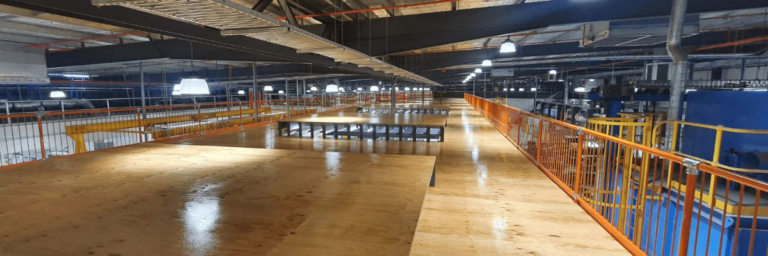
Mezzanine floors play a pivotal role in optimizing space and improving operational efficiency in warehousing and logistics. These intermediate floors, constructed within the vertical space of a warehouse, allow businesses to maximize their storage capacity and streamline logistics processes without the need for significant infrastructure expansion. Their versatility, cost-effectiveness, and ability to adapt to dynamic needs make them indispensable in modern warehousing and logistics.
Key Benefits of Mezzanine Floors in Warehousing and Logistics
1. Maximizing Vertical Space
- Optimal Utilization: Mezzanine floors capitalize on unused vertical space, effectively doubling or tripling the storage area within the same footprint.
- Cost-Effective Expansion: Avoids the need to construct new facilities or relocate to larger warehouses, saving both time and money.
2. Enhancing Storage Capacity
- Increased Inventory Space: Allows warehouses to accommodate more inventory, which is especially beneficial during peak seasons or for growing businesses.
- Customized Solutions: Mezzanine floors can be designed to handle specific types of goods, such as heavy equipment, pallets, or lightweight items.
3. Streamlining Operations
- Workflow Segmentation: Segregates different processes, such as picking, packing, and shipping, across multiple levels for better efficiency.
- Dedicated Zones: Creates specialized areas for different functions, such as order processing, quality control, or equipment storage.
4. Improving Accessibility
- Organized Layouts: Mezzanine floors enable systematic arrangement of inventory, making it easier for workers to locate and retrieve items.
- Reduced Congestion: By spreading operations across multiple levels, mezzanines help alleviate ground-level congestion, enhancing safety and productivity.
5. Adapting to Evolving Needs
- Scalability: Mezzanine floors can be expanded, reconfigured, or relocated to meet changing business demands, ensuring long-term usability.
- Flexibility: Suitable for various applications, from storage to office spaces or equipment housing within a warehouse.
Applications of Mezzanine Floors in Warehousing and Logistics
1. Storage Optimization
- High-Density Storage: Used for palletized goods, cartons, or small parts.
- Bulk Storage: Ideal for storing large or heavy inventory.
2. Order Fulfillment Zones
- Picking and Packing Areas: Dedicated mezzanine levels for order preparation streamline fulfillment processes.
- E-Commerce Operations: Accommodates increased inventory and sorting requirements for online retail businesses.
3. Equipment Housing
- Machinery Placement: Provides space for equipment like conveyor belts, forklifts, or automated systems.
- Tool Storage: Creates organized zones for storing tools and maintenance equipment.
4. Administrative Spaces
- Office Areas: Incorporates offices or meeting rooms within warehouses without sacrificing ground-level storage.
- Control Rooms: Houses management or monitoring stations for warehouse operations.
Key Features of Mezzanine Floors for Warehousing and Logistics
- Durability and Load Capacity:
- Designed to withstand heavy loads, making them suitable for storing goods and housing equipment.
- Materials like steel ensure structural integrity and long-term performance.
- Custom Design:
- Tailored layouts to fit specific warehouse requirements and integrate seamlessly with existing workflows.
- Accessibility Features:
- Equipped with stairs, lifts, or conveyors for easy movement of goods and personnel between levels.
- Safety Standards:
- Includes guardrails, anti-slip flooring, and fire safety systems to ensure worker safety.
- Quick Installation:
- Prefabricated components allow for fast assembly with minimal disruption to operations.
Challenges Addressed by Mezzanine Floors
- Space Constraints: Provides a cost-effective alternative to relocating or constructing additional facilities.
- Seasonal Demands: Accommodates increased inventory during peak seasons or promotions.
- Operational Bottlenecks: Enhances workflow efficiency by creating separate zones for different activities.
Advantages Over Traditional Expansions
| Feature | Mezzanine Floors | Traditional Expansion |
|---|---|---|
| Cost | Low | High |
| Time for Completion | Quick installation | Lengthy construction timelines |
| Scalability | Easily expandable and relocatable | Limited scalability |
| Impact on Operations | Minimal disruption | Significant operational downtime |
Future Trends in Mezzanine Floors for Warehousing
- Integration with Automation:
- Designed to support automated storage and retrieval systems (AS/RS).
- Seamless integration with robotics and conveyor systems.
- Smart Technology:
- IoT-enabled sensors to monitor load capacity and structural health.
- Integration with warehouse management systems (WMS).
- Sustainability:
- Use of recyclable materials and energy-efficient lighting to align with green building practices.
Frequently asked questions
Can a mezzanine be removed or moved later?
Yes. Bolted steel mezzanines can be dismantled and re-erected, which makes them a flexible investment.
Do I need approvals for a mezzanine?
Requirements vary by building and use. We provide drawings and structural details that your consultant or building owner can use for any approvals needed.
What is a mezzanine floor?
A mezzanine is an intermediate steel floor built inside a tall building to add usable area for storage, offices or production without extending the building.